
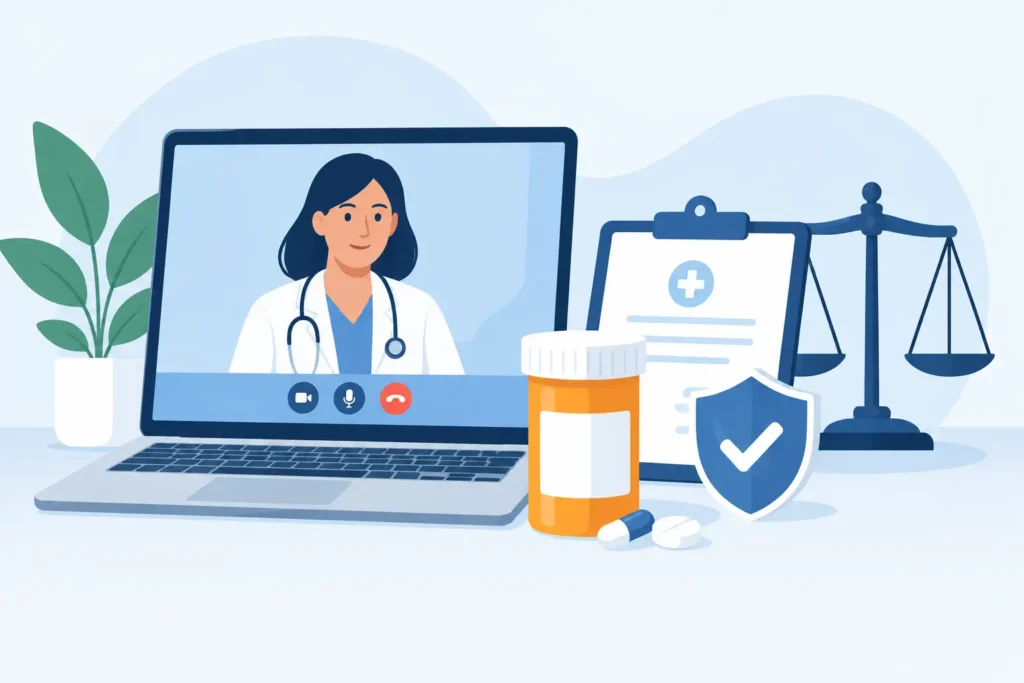
Ordering medication online can save time, protect privacy, and make refills easier to manage. But the legal requirements for online prescriptions do not disappear because the order happens on a website. In the US, a prescription medicine must still come from a legitimate medical decision, be filled by a properly licensed pharmacy, and be dispensed under federal and state rules.
For medications with misuse or overdose risks, including stimulants, benzodiazepines, opioid pain medicines, sleep medications, and opioid-use-disorder treatments, the rules are often stricter. A low price, overnight-shipping promise, or easy checkout page is never proof that a source is legal or safe.
A valid prescription comes first
A legal online prescription begins with a valid prescription from a clinician authorized to prescribe in the state where the patient is located. Depending on the medication and state law, that clinician may be a physician, nurse practitioner, physician assistant, dentist, or another licensed professional acting within their scope of practice.
A valid prescription is not simply a medication name and a quantity. It is based on a real patient-provider relationship and a legitimate medical purpose. The prescriber must review relevant health information, assess whether the medication is appropriate, consider interactions and contraindications, and document the encounter according to applicable rules.
This is why legitimate care may involve questions about medical history, current prescriptions, allergies, pregnancy status, substance-use history, prior treatment, and symptoms. It can feel slower than adding a product to a cart, but those checks are part of lawful prescribing and safer treatment.
Telehealth can be legal, but it is not a shortcut
Telehealth visits can support legal prescribing. Video appointments, secure patient questionnaires, follow-up calls, and electronic records are commonly used in modern care. However, telehealth does not mean every medication can be prescribed to every person without clinical review.
State law matters because the patient is generally considered to receive care in the state where they are physically located during the appointment. A clinician must usually hold the appropriate license or authorization for that location. A provider licensed in one state may not automatically be able to prescribe to a patient in another.
Telehealth platforms should clearly identify the clinician, explain how the evaluation works, provide a way to ask medical questions, and give patients access to follow-up care. If a site promises prescription-only medicine with no evaluation, no prescriber details, and no health screening, that is a serious warning sign.
Special rules for controlled medications
Controlled substances have additional federal oversight under the Controlled Substances Act. This category includes many medicines used for ADHD, anxiety, insomnia, pain, and opioid-use-disorder treatment. Examples may include amphetamine-based ADHD medications, certain benzodiazepines, oxycodone products, hydrocodone products, and some sleep medicines.
For these medications, prescribers must be properly registered with the Drug Enforcement Administration, and prescriptions must meet DEA and state requirements. The Ryan Haight Online Pharmacy Consumer Protection Act also limits the online prescribing and dispensing of controlled substances, particularly when there has not been an appropriate medical evaluation.
Federal telemedicine rules for controlled medicines have changed over time, including temporary policies and extensions. Because these rules can expire or be replaced, patients and providers should confirm the current DEA and state requirements before relying on a telehealth prescription. The practical point is simple: a controlled medication should never be sold as an ordinary retail item with no verified prescription and no clinical assessment.
The pharmacy must be licensed where it operates and dispenses
A legal prescription also needs a legitimate pharmacy. Online pharmacies are not exempt from the licensing rules that apply to neighborhood pharmacies. They must be licensed by the relevant state pharmacy boards and meet standards for storage, dispensing, labeling, patient records, counseling, and privacy.
Many legitimate mail-order pharmacies are licensed in more than one state because they ship across state lines. The pharmacy should be able to provide its physical location, pharmacy license information, pharmacist contact details, and a clear process for transferring or verifying a prescription.
A real pharmacy requires a prescription for prescription-only medicine. It does not offer to send controlled medication based on a product selection alone, and it does not treat a customer-uploaded image as a substitute for verifying the order when verification is required.
Look for practical signs of accountability: a listed pharmacist, a US address, a working phone number, privacy practices, secure payment processing, and patient support that can answer medication questions. A website that hides its location, will only communicate through anonymous messaging apps, or insists on unusual payment methods deserves extra caution.
Prescription verification and dispensing rules matter
Once a prescription reaches the pharmacy, the pharmacist has legal and professional responsibilities. Pharmacies review prescriptions for accuracy, possible duplication, dosage concerns, allergies, and drug interactions. They may contact the prescriber before dispensing when something appears unclear or unsafe.
Patients sometimes see this as a delay, especially when they need medication quickly. Yet verification protects patients from preventable errors and helps stop forged, altered, or improperly issued prescriptions. It is particularly relevant when a person takes multiple medications that can cause sedation, breathing problems, heart effects, or other serious interactions.
Controlled-substance prescriptions may also be reported to a state prescription drug monitoring program. These databases help authorized clinicians and pharmacists identify unsafe combinations, overlapping prescriptions, or patterns that require a closer review. Requirements differ by state and medication category.
Shipping does not erase state and federal law
Mail delivery is allowed for many legally prescribed medicines, but shipping rules depend on the medication, the sender, and the destination. A pharmacy cannot lawfully ship a prescription drug wherever it chooses simply because an online order was placed.
For controlled substances, mailing requirements can be especially strict. The pharmacy, prescriber, and patient must all meet applicable rules, and shipping may be limited by state laws or pharmacy licensing. Refrigerated medications, drugs with misuse potential, and medicines requiring special monitoring can involve additional handling requirements.
International orders are even more complicated. A medication that is legal in one country may be restricted, unapproved, counterfeit, mislabeled, or seized at the border in another. Importing prescription medicines into the US for personal use is not a reliable legal workaround, even when a foreign website claims worldwide delivery. Customs rules, FDA requirements, and controlled-substance laws can all apply.
Privacy is required, but privacy is not anonymity
Legitimate healthcare businesses protect personal health information and use secure systems for patient records and prescription data. Depending on the organization and how it handles health information, federal privacy rules such as HIPAA may apply, along with state privacy and breach-notification laws.
Privacy should mean secure handling of sensitive details, not a promise that no one will review your medical information. A lawful provider and pharmacy need enough information to verify identity, assess safety, process the prescription, and meet recordkeeping requirements. Be cautious when a site asks for unnecessary personal documents, but be equally cautious when it asks for almost nothing at all.
Red flags that should stop an order
A legal online prescription process is designed around verification, not speed at any cost. Stop and investigate further if a website does any of the following:
- Offers prescription or controlled medicines without a valid prescription.
- Promises guaranteed approval regardless of medical history.
- Does not identify a licensed clinician or pharmacist.
- Uses only cryptocurrency, gift cards, wire transfers, or other hard-to-reverse payments.
- Lists no verifiable pharmacy address, state license, or customer-support phone number.
- Encourages patients to bypass their current doctor, pharmacy, or local laws.
The same caution applies to medication that arrives in damaged packaging, without a proper label, with unfamiliar markings, or with instructions that do not match what a clinician prescribed. Do not take it until a pharmacist or healthcare professional has reviewed it.
Know what a lawful process should feel like
For most patients, the safest path is straightforward: use a qualified clinician, receive a real evaluation, fill the prescription through a licensed pharmacy, and keep communication open if symptoms or side effects change. Convenience matters, and online care can be a useful option, but convenience should sit inside the legal and clinical safeguards that protect patients.
If you are unsure whether an online prescription source is legitimate, pause before paying. A few minutes spent confirming the prescriber, pharmacy license, and prescription process can prevent counterfeit medication, legal trouble, financial loss, and serious harm.